
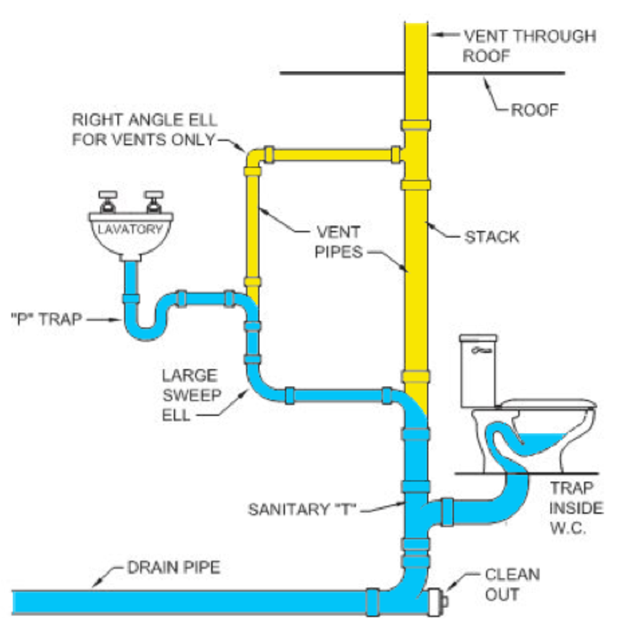
Introduction:
One of the most important aspects of designing DWV systems is having the wastewater and solid waste flow as quickly as possible to the building drain. When water and solid waste enters into the main stack from a fixture drain, it must enter through a long turn tee-wye or a sanitary tee. This is to ensure the flow has enough momentum and directs the flow to enter the stack in a downward direction (Soo Hoo & Frankel, 2006). Once the waste enters the stack, the force of gravity pulls the flow downward. The flow coats the inside of the pipe in the form of a sheet, leaving a central core of air. We will discuss the importance of the air core in the next section (Soo Hoo & Frankel, 2006). The flow will continue to accelerate down the pipe until the force of friction on the flow equalizes to the force of gravity. Once this happens, the flow will continue down at the same velocity, called the terminal velocity (Soo Hoo & Frankel, 2006). The terminal velocity is defined as the maximum vertical velocity the sheet of water will attain. The distance the sheet of water must fall to obtain the vertical velocity is called the terminal length (Soo Hoo & Frankel, 2006). By calculating these using fancy formulas, the pipe diameter and length can be determined.
Now back to the importance of the air core. As anyone who has ever performed a shotgun would know, you need to open the beer can at the top to make sure you can crush the shotgun efficiently. And that is because without air being able to vent the flow in the pipes, a vacuum will form, eventually stopping the flow. In DWV systems, the air is required to push the flow down and ensures that P-traps will not lose their water seal, which is integral to ensure that foul gases to not escape into living spaces and reek up the whole place. Looking again at figure 1, the pipes in yellow are utilized as venting to ensure efficient flow of the waste and to prevent ‘gurgling’ of the water as it flows down. The size of the vents in determined similar to how the drainpipes are calculated, but replacing water with air as the medium.
Real World Application
Now you might be thinking ‘This is all very interesting, but why should I care?’. And it’s true that you may go years without seeing any drainage issues, especially if the initial design is done properly. But when blockages do occur, the consequences can be quite steep. Water backing up and damaging flooring, walls or possessions is not on anyone’s wishlist. And remember it’s not just water in those pipes. The water is being used to carry solids, the type that none of us really want to see. Let me tell you, there is nothing that makes you appreciate the brilliance of waste removal piping more than seeing a giant slog of waste fill up a pipe.
And that is assuming the initial drainage was designed properly. We have gone into many situations where, although the piping is done to code, the choice of fittings used can cause major issues as they are prime spots for solids to build up, especially on turns as the drain pipe enters the main stack. And if you are a restaurant owner or deal with any type of grease or oil, then drainage issues can really compound.
The remedy
So how to deal with this? Regular inspection and maintenance is key to ensuring your drain pipes are operating as they should. PHD follows a 4 step procedure to maintain the state of drain pipes:
1. Perform inspection using an Inspection Camera and use of a locator to determine location of blockage, if any.
2. Use an appropriately sized drain cleaner to clear away up the blockage
3. If the drain machine not effective, a commercial grade Hydroflush machine is used to blast away the blockage
4. Inspect once more with camera to ensure blockage is cleared
So now that you know more than you have wanted to about how (insert your favorite word here) flows, you know how important it is to have regular maintenance performed on your lines.
We at PHD are experienced with many types of situations.
References:
1. Plumbing Stack Repair – Maplewood Plumbing. (2021). Retrieved 21 July 2021, from https://maplewoodplumbing.com/residential-plumbing/outdoor-plumbing/plumbing-stack-repair-restoration/)
2. Soo Hoo, W., & Frankel, M. (2006). Plumbing Engineering Design Handbook Volume 2: Plumbing Systems (p. 2). Chicago: American Society of Plumbing Engineers.